SAP Business AI Platform (BAIP): What’s New, What Changed from BTP, and What It Means for SAP Customers
TL;DR
- SAP Business AI Platform (BAIP) launched at SAP Sapphire 2026, consolidating SAP’s AI foundation layer with SAP Business Technology Platform (BTP) and SAP Business Data Cloud (BDC) into one unified platform, with SAP Knowledge Graph at its core.
- BAIP is the foundation of SAP’s “Autonomous Enterprise” vision, alongside SAP Autonomous Suite (50+ Joule Assistants executing business operations) and Joule Work (the new user experience layer).
- No forced migration: existing SAP BTP investments, certifications, and integrations carry forward unchanged under BAIP.
- SAP BTP partner competencies were renamed to SAP BAIP competencies on June 30, 2026, with further specialization and certification changes rolling out through January 2027.
- Inside the platform: Joule Studio for building agents, the SAP AI Agent Hub for governing them, and partnerships with Anthropic, AWS, Google Cloud, Microsoft, NVIDIA, Mistral AI, and Cohere. Running on top of it: SAP Autonomous Suite finance assistants (rolling out Q2–Q4 2026) and Industry AI solutions.
- For SAP customers, BAIP raises the importance of clean-core posture and custom code visibility, regardless of where they are in their ECC-to-S/4HANA migration journey.
If you work anywhere near an SAP landscape in 2026, you’ve probably seen “BAIP” show up in partner emails, SAP Sapphire 2026 recaps on LinkedIn, or a vendor deck without much explanation.
The short version: SAP BTP hasn’t disappeared, but it’s now part of something bigger.
This article breaks down what the SAP Business AI Platform (BAIP) actually is, how it relates to SAP Business Technology Platform (BTP), Joule Studio, and SAP Business Data Cloud (BDC). Then it gets specific about what this means depending on where you sit: on ECC and mapping migration timing, already committed to SAP BTP, managing custom ABAP objects, or still deciding whether to commit to SAP BTP at all.
What Is the SAP Business AI Platform (BAIP)?
SAP BAIP was launched by SAP CEO Christian Klein at SAP Sapphire 2026 in Orlando. It’s positioned as the foundation of SAP’s broader “Autonomous Enterprise” vision, enabling AI-powered business processes where AI agents, not just AI assistants, will increasingly run core business processes while people focus on judgment calls and exceptions.
It is SAP’s answer to a question a lot of enterprise AI buyers have been asking: where should AI actually live relative to ERP, data infrastructure, and business applications?
Structurally, SAP BAIP consolidates SAP’s AI foundation layer, SAP BTP, and SAP BDC into a single, governed offering, with SAP Knowledge Graph at its core, giving AI agents a structured map of your business processes and data. In other words, SAP BAIP isn’t a brand-new product built from scratch. It’s an architectural rationalization of tools SAP customers already know, such as SAP BTP, SAP BDC, and Joule, brought under one roof with a shared governance and agent-building layer on top.
If you’ve been using SAP BTP for integration, extension, and application development, or SAP BDC for unified data and analytics, SAP BAIP is the umbrella that now sits above both, designed as a single enterprise AI platform, rather than a loose collection of new AI features added to existing products.
How SAP BAIP Is Structured: Context, Build, Govern
SAP CTO Philipp Herzig described the platform as three layers, and this is the clearest way to see how BTP, BDC, and Joule Studio now fit together:
- Context layer: SAP Knowledge Graph, new SAP Domain Models trained on SAP’s code, and SAP BDC as a single semantic data layer across SAP and non-SAP data. This is what grounds agents in how your business actually runs.
- Build layer: Joule Studio, SAP’s environment for building custom AI agents, apps, and workflows, with both no-code and pro-code options.
- Governance layer: SAP AI Agent Hub, built on SAP LeanIX, a single place to discover and govern AI agents, LLMs, and MCP servers, whether SAP-built or not.
Where Does SAP Business AI Platform Fit in the Autonomous Enterprise?
SAP’s Autonomous Enterprise vision rests on three pieces:
- SAP Business AI Platform: Where AI agents are built, contextualized, and governed
- SAP Autonomous Suite: Where those agents actually execute core business operations, through more than 50 Joule Assistants orchestrating 200+ specialized agents across finance, spend, supply chain, HCM, and CX, rolling out over the coming months
- Joule Work: The user experience layer through which people interact with SAP systems and agents
SAP also introduced Industry AI alongside this, which are seven autonomous solutions that embed sector-specific process logic and regulatory requirements directly into vertical workflows.
This is a bold bet on agentic AI as the next stage of enterprise software, where systems don’t just surface insights but act on them inside defined guardrails. Understanding this structure matters because SAP BAIP isn’t meant to be evaluated in isolation. It’s the foundation on top of which the rest of SAP’s AI strategy is being built.
SAP BAIP vs BTP: What Actually Changed?
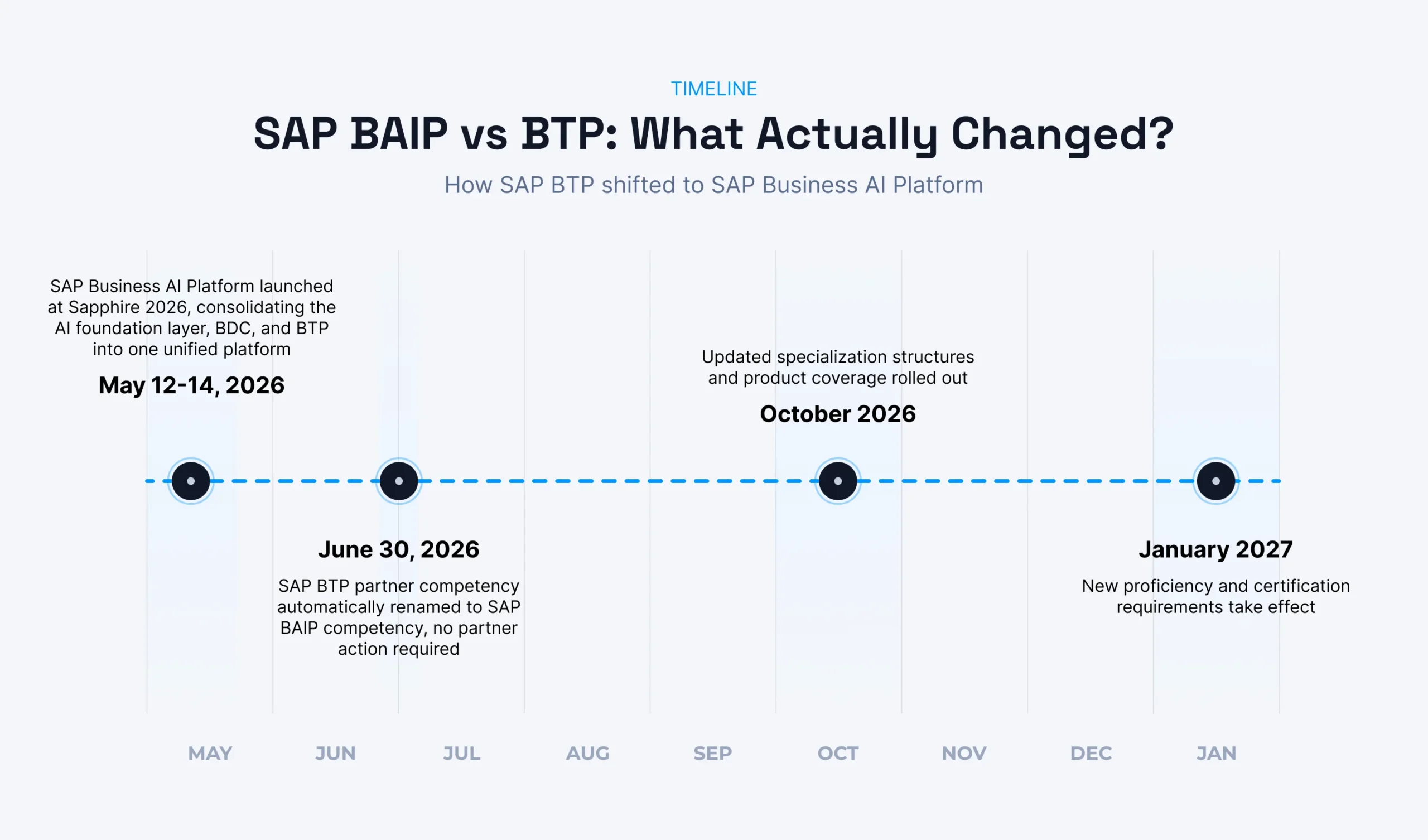
Here’s the timeline of how SAP BTP shifted to SAP Business AI Platform :
|
Date |
Milestone |
|
May 12–14, 2026 |
SAP Business AI Platform launched at SAP Sapphire (Orlando), consolidating SAP’s AI foundation layer, SAP BDC, and SAP BTP into one unified platform |
|
June 30, 2026 |
SAP BTP partner competency automatically renamed to SAP BAIP competency, no partner action required |
|
October 2026 |
Updated specialization structures and product coverage rolled out |
|
January 2027 |
New proficiency and certification requirements take effect |
1. From Platform Launch to Partner Program Rollout
The platform launched at SAP Sapphire in May 2026. The partner-side change followed: SAP BTP competencies were renamed to SAP BAIP competencies automatically on June 30, 2026, with the October 2026 and January 2027 changes shown in the table above.
It’s important to separate these two things clearly, because they get confused a lot: the SAP BTP to BAIP shift at the platform level happened at Sapphire; the partner competency rename is a downstream administrative rollout, not the main event.
2. Consolidation, Not Replacement
The core of the difference between SAP BTP and BAIP is architectural, not functional replacement. SAP BDC and SAP BTP have been folded into a single control plane for agents, data, and compliance. But the services you already run on SAP BTP, such as integration flows, extension apps, and application development, continue operating as they do today.
Your existing SAP BDC data products remain the operational foundation underneath the new AI layer.
3. Is SAP BAIP a Rebrand or a Real Shift?
Depending on where you look, it can be both. At the partner competency and labeling level, the underlying services are the same, it just has a new name.
At the platform and strategic level, it’s a genuine shift with SAP explicitly framing this as moving from being “just an ERP company” to positioning itself as a business AI platform provider, with AI foundation, data, and governance unified under one architecture instead of scattered across separate product lines.
SAP Business AI Platform Features and Capabilities
Here’s what SAP announced, split between what’s in the platform itself and what runs on top of it. Availability varies by capability, so check current status before planning around any single one.
In the platform:
- SAP AI Agent Hub: Built on SAP LeanIX, it discovers and governs AI agents, LLMs, and MCP servers, SAP and non-SAP alike, and is included at no additional charge, including building, deploying, and monitoring AI agents. This gives IT teams a single place to track what agents exist and what they’re allowed to touch. Registry and lifecycle governance were generally available at launch, with the remaining capabilities planned for Q3 2026.
- Model and ecosystem partnerships: Anthropic’s Claude is among the foundation models powering Joule agents; AWS brings zero-copy data integration between SAP BDC and Amazon Athena; Google Cloud and Microsoft enable agent-to-agent interoperability with Joule; NVIDIA’s OpenShell provides the secure runtime for Joule Studio; and Mistral AI and Cohere deliver sovereign model options on SAP’s cloud infrastructure, so customers aren’t locked into a single AI provider.
- SAP Autonomous Suite finance assistants (for RISE with SAP and SAP GROW Cloud customers): Including a Financial Closing Assistant, Billing Assistant, Tax and Compliance Assistant, and Accounts Receivable Assistant, which reached general availability in the second quarter of 2026; a Cash and Treasury Assistant available through SAP’s Early Adopter Care program in the same window; a Financial Planning Assistant targeted for general availability in the third quarter of 2026; and a Governance Assistant targeted for the fourth quarter of 2026.
- Industry AI solutions: Deep process and vertical expertise are directly embedded into industry-specific workflows. This aims to close the gap that normally stalls AI adoption in regulated or highly specialized industries.
Taken together, these SAP Business AI Platform capabilities point toward a specific goal: grounding agentic AI in actual business context rather than letting agents operate as generic chatbots layered on top of SAP.
What Stays the Same on the SAP Business AI Platform
For SAP customers worried this means starting over, it doesn’t.
There’s no forced migration tied to the SAP BTP to BAIP transition. Existing SAP BTP certifications, competencies, and investments carry forward. Existing SAP BDC data products and SAP BTP integration flows remain the foundation everything else sits on top of.
The platform is additive right now, not disruptive, though that could shift as more of the Autonomous Suite and Industry AI capabilities mature in 2027 and beyond.
What the SAP Business AI Platform Means for Different SAP Customers?
Here’s what these changes mean in practice, depending on where you sit today.
Customer Profile | What Changes / Stays the Same | What It Means for You |
IT / Enterprise Architecture Lead on ECC 6.0 (EHP5–8) | The S/4HANA migration timeline and the end-2027 mainstream maintenance deadline for EHP6–8 haven’t moved (optional extended maintenance runs to 2030). If you’re on EHP5 or below, mainstream maintenance already ended on December 31, 2025. | The platform you’re migrating into now looks different than what was scoped a year ago, so it’s important to factor SAP Business AI Platform into your architecture planning and vendor conversations from the outset. Also note: SAP is giving ECC and S/4HANA on-premise customers access to select AI scenarios only if they commit to moving most of their landscape to SAP Cloud ERP, while RISE with SAP customers get three Joule Assistants activated in their first year. Your migration commitment now affects your AI access too. |
CIO / VP of IT Strategy who’s committed budget to SAP BTP | Your SAP BTP spend isn’t isolated, since SAP Business AI Platform builds on SAP BTP rather than replacing it. | Update your roadmap conversations with your SAP account team to explicitly reference SAP BAIP and the Autonomous Enterprise vision, so you’re not planning against an outdated product map. |
SAP Basis / COE team managing custom ABAP | The AI Agent Hub and the broader AI governance layer raise the stakes on clean core. | Custom objects that haven’t been rationalized become harder to govern as AI agents start operating across the SAP landscape, which makes custom code visibility more urgent than it was before. |
Pre-license prospect deciding whether to commit to SAP BTP | SAP BTP remains the foundation that SAP Business AI Platform is built on top of. | Ask your SAP rep how your specific use cases map onto SAP BAIP’s governance and agent capabilities before signing. |
Should SAP Customers Act on SAP BAIP Now, or Wait?
There’s no urgent action forced purely by the partner competency rename. The October 2026 and January 2027 milestones should be tracked, but they’re not deadlines that require an immediate response from most customers.
What is important to start now, regardless of where SAP BAIP rollout timing lands, is –
- basic environment readiness with clean data,
- an accurate picture of your custom code footprint,
- and a genuinely clean-core posture.
None of that work is wasted, whatever pace SAP’s AI roadmap ends up moving at.
One more thing to factor in: SAP also announced agent-led migration tooling that it says can cut ERP migration effort by more than 35%. That will speed up execution, but it doesn’t replace knowing what’s in your custom code estate before you start
Switching to SAP Business AI Platform with A5E Consulting
The platform conversation around SAP BTP, SAP Business AI Platform, and the Autonomous Enterprise is still evolving, and it will continue through 2027. But the fundamentals underneath it, like clean core, visibility into custom code, and migration readiness, matter more under an AI-first platform.
If you're trying to figure out where your own SAP environment stands before layering more AI capability on top of it, A5E's MIRA custom code assessment is a practical place to start.
Get your custom code assessmentFAQ
FAQ
Related Posts
Post a Comment cancel reply
You must be logged in to post a comment.