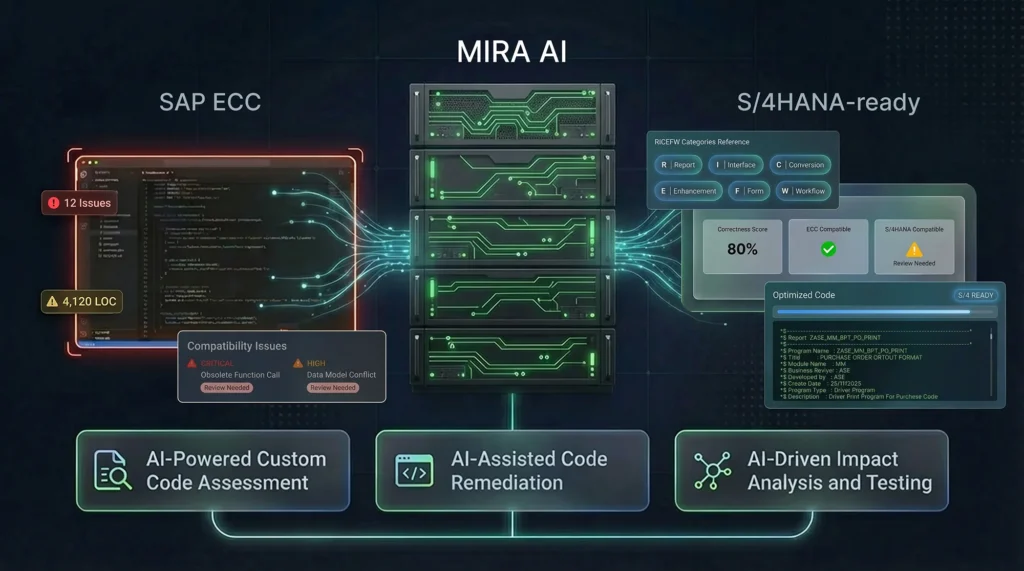
To address these challenges, organizations are increasingly turning to AI-driven platforms designed specifically for SAP transformation programs. One example is MIRA (Migration Intelligence & Remediation Application ) developed by A5E Consulting, an AI-driven platform designed to automate SAP ECC to S/4HANA migration activities while maintaining human-in-the-loop controls for accuracy, governance, and auditability across the migration lifecycle.
AI does not replace SAP or ABAP expertise. Instead, it acts as an intelligent accelerator, helping teams focus on what truly matters and reducing the manual burden of analysis and remediation.
1. AI-Powered Custom Code Assessment
A key first step in any S/4HANA migration is understanding the true state of custom code. AI-driven custom code assessment tools can scan thousands of custom ABAP objects rapidly and at scale. Instead of producing long technical lists, AI helps classify code based on impact and relevance.
MIRA ingests custom code from ECC systems, repositories, and integrations into a centralized platform, eliminating manual audits. It standardizes ABAP logic, SQL, and table references while using dependency analysis and historical patterns to align legacy code with S/4HANA requirements.
For example, AI can identify:
- Code that is already compatible with S/4HANA
- Code that requires specific remediation
- Code that is rarely used and can potentially be retired
By incorporating usage data and dependency mapping, AI enables risk and value based prioritization. This gives organizations a far clearer picture of the real effort required, supporting more accurate planning and budgeting.
2. AI-Assisted Code Remediation
Once high-priority objects are identified, AI can support developers during remediation. By recognizing patterns across similar ABAP programs, AI models can suggest context-aware fixes for common issues such as:
- Replacing obsolete tables with their S/4HANA equivalents
- Updating syntax or function calls to align with modern standards
- Adjusting logic for improved HANA performance
Developers remain in control, validating and refining suggestions. However, instead of starting from a blank screen, they work from intelligent recommendations. This significantly reduces effort and accelerates custom code migration without compromising quality.
For instance, if multiple custom reports reference deprecated ECC tables such as MKPF or MSEG, AI can automatically recommend their S/4HANA-compatible equivalents and suggest optimized queries for HANA.
3. AI-Driven Impact Analysis and Testing
Testing is another major cost driver in ECC to S/4HANA migrations. Traditionally, large regression test cycles are required because it is difficult to pinpoint exactly which business processes are affected by a given code change.
AI helps by analyzing usage data, dependencies, and execution patterns to trace where custom code is triggered within transactions and how it supports specific business processes. This supports:
- More targeted regression testing focused on impacted areas
- Reduced testing scope without increasing risk
- Faster stabilization and fewer post-go-live defects
By linking technical change analysis to business impact, AI makes testing more efficient and more aligned with real operational risk.
Business Outcomes: How AI Changes ECC to S/4HANA Migration Economics
The use of AI in custom code transformation is not just a technical improvement, it also has a direct impact on migration economics and risk profiles.
Organizations that adopt AI-driven approaches typically see:
- Shorter migration timelines through faster analysis and remediation cycles
- Lower remediation costs by reducing manual effort and rework
- Improved risk visibility with better forecasting of effort and impact
- Cleaner post-migration systems as unused or redundant custom code is identified and retired
For IT leaders, this means greater confidence in planning and fewer last-minute surprises.
For program managers, it brings improved predictability and control.
For enterprises with heavily customized ECC systems, it reduces the overall risk associated with large-scale ERP transformation.
From AI Insight to Execution: The A5E Approach
Successfully delivering SAP S/4HANA migration with AI requires more than technology alone. It demands deep SAP and ABAP expertise combined with intelligent automation and analytics.
A5E Consulting brings these elements together through a structured, AI-enabled migration approach. Alongside hands-on migration services, A5E leverages MIRA (Migration Intelligence & Remediation Application), its AI-powered code intelligence platform designed specifically for custom code transformation. This platform supports:
- Comprehensive custom code discovery across ECC landscapes
- Risk-based prioritization that aligns technical findings with business impact
- AI-assisted remediation planning to streamline developer effort
By integrating AI-driven insight into every stage of the journey, A5E helps organizations move from reactive code fixing to a proactive, data-driven migration strategy.
Making Custom Code Migration Predictable
Custom ABAP code is often the biggest unknown in any S/4HANA migration, and one of the most significant sources of risk. Left unmanaged, it can lead to delays, cost overruns, and business disruption. With the right use of AI, however, it can be analyzed, prioritized, and transformed in a far more controlled and efficient way.
By combining an AI-powered code intelligence platform, intelligent remediation support, and business-focused impact analysis, enterprises can turn SAP custom code migration from a bottleneck into a structured and predictable process.
Organizations planning an ECC to S/4HANA migration can take the first step by leveraging A5E’s MIRA (Migration Intelligence & Remediation Application) for custom code assessment, remediation planning, and early risk visibility.
Contact us today for a demo or consultation