MIRA: A Process-First Approach to SAP Custom Code Migration
TL;DR
- 60% of SAP S/4HANA migrations exceed budget or schedule; 65% report quality deficits post-go-live
- The root cause is usually custom code: teams try to inventory and convert everything, including code nobody uses anymore
- MIRA, A5E Consulting’s SAP custom code migration suite, takes a process-first approach: streamline the custom code estate first, then remediate only what survives
- MIRA has three parts you can engage independently: Advisory (roadmapping), Platform (the assessment engine), and Clean Core (ongoing compliance)
- The entry point is a simple, fixed-price, fixed-scope SAP migration assessment, not an open-ended migration that runs into millions of dollars of budget
- Getting scope right upfront is the single biggest lever on your SAP implementation TCO
Did you know? 60% of SAP S/4HANA migrations exceed budget or schedule. Less than 10% are complete on time. And once the project wraps up, 65% of teams still report quality issues after go-live.
These numbers repeat across industries, company sizes, and SAP versions. They’re a big reason digital transformation roadmaps stall before they start. If you’re one of the many organizations staring down the 2027 deadline for SAP ECC mainstream maintenance, the numbers should give you pause.
So why do so many well-funded, well-staffed SAP S/4HANA migration projects still blow past their budget and their deadline?
Most S/4HANA migration teams start with a baseline assessment of their existing code. Every custom ABAP object gets logged, assessed, and queued up for conversion, no matter how old, how obscure, or how rarely it’s actually used.
It feels thorough. It’s also usually where the trouble starts.
Ninety-five percent of SAP organizations run significant custom ABAP code, built up over years of one-off fixes, workarounds, and business-specific tweaks that made sense at the time. When a migration team sets out to convert all of its custom code, the scope of work they’re working with is far bigger than it needs to be, inflating SAP migration costs.
But it doesn’t have to be this way.
By following a process-first SAP migration strategy, you can streamline your custom code before jumping into conversion. This changes the entire cost and risk profile of your SAP ECC to S/4HANA migration.
That’s the thinking behind MIRA, A5E Consulting’s SAP custom code migration suite for SAP modernization.
Instead of asking “how do we migrate all the objects,” MIRA starts by asking “what actually needs to survive the move.” The rest of this article walks through why this approach matters, and how MIRA puts it into practice.
Why SAP Migrations go over Budget and Behind Schedule
Here’s the reason behind that 60% figure: most SAP S/4HANA migration projects start by baselining their entire custom code program. Every custom ABAP object gets logged, assessed, and slated for conversion. This is time and labor-intensive, leading to budget overruns – one of the most common SAP Cloud migration issues organizations run into once they move past planning and into execution.
When a migration team tries to convert all the custom ABAP code built up over the years, three things happen:
- Scope balloons past the original estimate
- Governance breaks down as more stakeholders get pulled in to “just check” old customizations
- The clock keeps running against a fixed deadline
SAP ECC mainstream maintenance ends December 31, 2027. Most SAP S/4HANA migration programs take 18 to 36 months. The runway is already tight and you don’t want to waste time untangling code you may not even need.
It’s no surprise that 44% of organizations cite excessive customizations as the number one blocker in their SAP ECC to S/4HANA migration. The code isn’t just technical debt. It’s the reason timelines slip.
The Real Problem Isn’t the Code, It’s the Process
Here’s our core belief with MIRA:
You should not migrate what you do not need.
It sounds obvious, but that’s how most of the industry approaches SAP custom code migration today. The default reflex is to inventory, assess, and convert everything. Some vendors go further and promise to transform 100% of your codebase, framing full-scope automation as the safest option.
We’d argue it’s the opposite. Full-scope conversion doesn’t reduce risk. It just moves all of your existing risk, including the risk sitting in code nobody uses, onto a new platform, at a higher cost, under a tighter timeline.
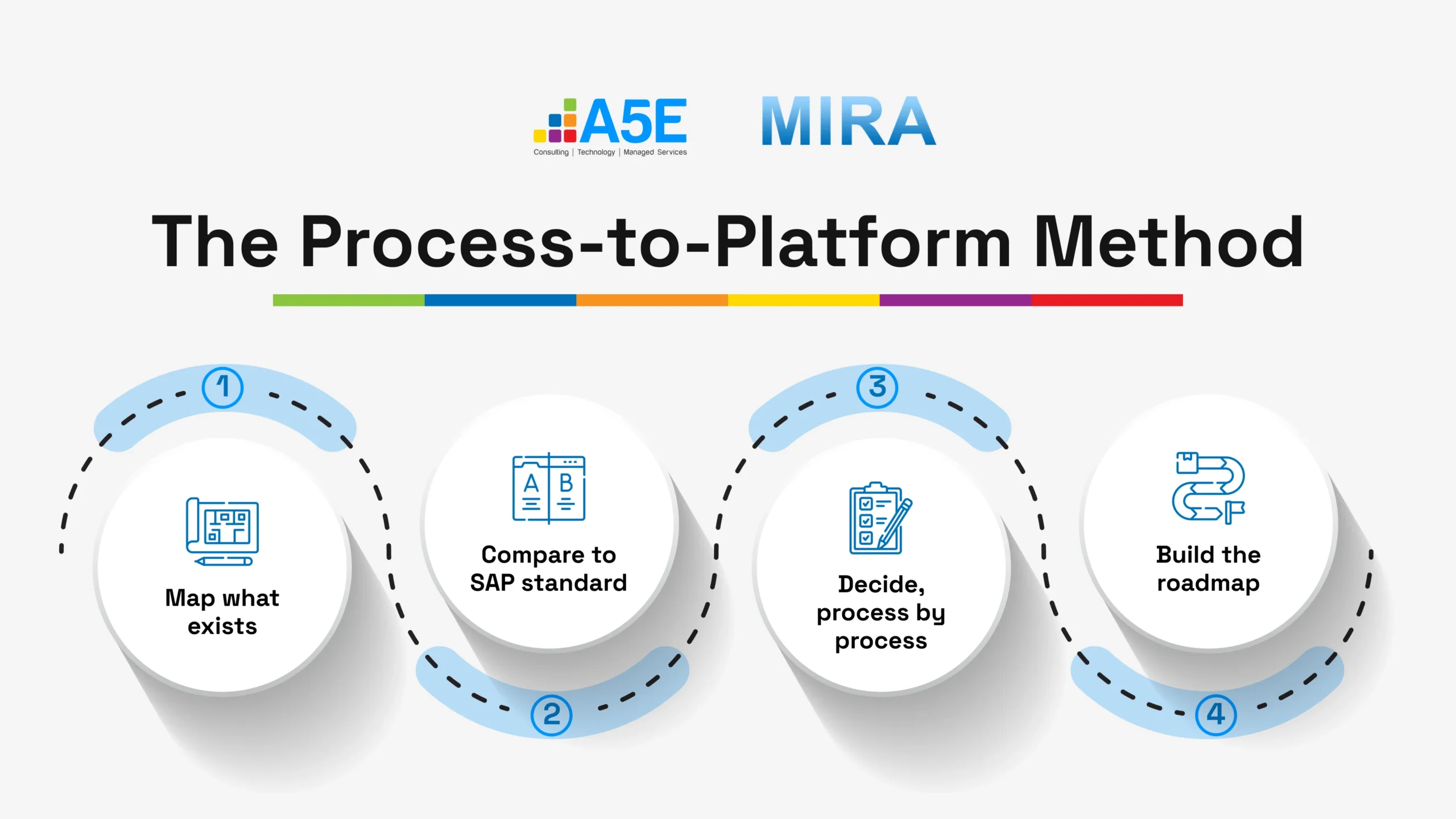
A process-first SAP migration process starts differently. Before anything gets converted, you map what actually exists, compare it against what the business still uses, and streamline the gap. Only then do you build a roadmap. This is the same logic behind SAP’s own clean core strategy guidance, and it’s the backbone of everything MIRA does.
Inside the A5E SAP Custom Code Migration Suite: MIRA
MIRA is a powerful suite of tools, experts and processes which you can engage irrespective of where you are in your digital transformation journey: whether that’s early-stage advisory, active assessment, or long-term clean-core governance.
MIRA Advisory |
MIRA Platform |
MIRA Clean Core |
|
MIRA Advisory runs on what we call the Process-to-Platform Method: our migration experts map your current landscape, compare it against your business needs, streamline what stays, and roadmap the path forward. The output is a Migration Roadmap with a clear, sequenced plan for what to assess, what to retire, and the order to tackle it in. Who is it for? This is the starting point if you’re still pre-license and need to build a credible business case before committing any budget. |
This is where the AI-accelerated migration work happens, including both assessment and remediation. MIRA Platform runs a fast, AI-accelerated custom code assessment across every piece of custom ABAP code you have, delivered within 48 hours and driven entirely by AI at this stage, with no manual review required. The output is a full custom code program report with compatibility gap analysis, risk scores, an effort model, and clear keep-or-retire recommendations, followed by AI-accelerated remediation of the code that survives. Remediation is where human expertise enters. Every remediated output goes through an A5E expert panel review before it reaches you. We call this knowledge layer first, then AI: human SAP expertise defines what “good” looks like, and AI accelerates the work within those guardrails. Built on SAP ATC and SAP’s own clean-core tooling, MIRA Platform doesn’t replace SAP’s systems; it works inside them. Who is it for? This is where you start once you need hard evidence on your custom code estate, not just a roadmap, when you’re ready to move from assessment into AI-accelerated remediation. |
Clean core isn’t a one-time checkbox. It’s an ongoing discipline, and that’s what MIRA Clean Core is built for. The output is continuous compliance checks against an extensive set of validation rules, scored against SAP clean-core principles and maturity model (the official A through D framework). Who is it for? Clean Core principles run through MIRA Advisory and MIRA Platform from the start, whether you’re roadmapping or remediating. Once you’re live on S/4HANA, MIRA Clean Core can also stand alone as an ongoing governance layer to keep your system compliant long after go-live. |
What This Means for Your Total Cost Of Ownership (TCO)
Put the pieces together, and the impact on TCO is where MIRA’s process-first thesis really pays off.
When you streamline your SAP custom code estate before remediation starts, you shrink the scope of what you’re paying to convert. You’re not spending the assessment and migration budget on code nobody touches. For the code that does survive, MIRA Platform’s AI-accelerated remediation compresses both the timeline and the cost of getting that code S/4HANA-ready.
“Across A5E’s 300+ engagements, we’ve consistently observed that a meaningful share of an organization’s custom code sees little to no real business use by the time a migration starts. This is a pattern we see again and again in our SAP consulting projects, and it’s exactly why assessment has to come before remediation, not after.”
Avkash Chauhan (AI & Data Architect)
MIRA doesn’t offer a fixed price for open-ended remediation, and we won’t hand you an AI-to-human effort ratio or a hard timeline before we’ve actually looked at your codebase. What we do offer is a fixed-price and a fixed-scope way to get that picture, fast.
Leverage the MIRA SAP Custom Code Migration Suite in 2026 for S/4HANA Migrations
Whether it’s the looming 2027 deadline, a new CIO asking hard questions, a board mandate you need to defend, or a System Integrator (SI) quote that is making your CFO uncomfortable, now is the time to get a real picture of your custom code estate, not another six-figure guess.
Here’s the takeaway in short:
- Process-first beats code-first: streamline before you remediate
- The custom code assessment is your entry point, not a formality
- Clean core is an ongoing discipline, not a one-time migration task
- Getting scope right upfront is the single biggest lever on your SAP migration’s TCO
Curious what your own custom code estate would show? Request your assessment to see where your SAP ECC to S/4HANA migration actually stands.
FAQ
FAQ
Related Posts
Post a Comment cancel reply
You must be logged in to post a comment.