We leverage our capabilities in Analytics, Data Sciences and AI/ML combined with Enterprise solutions, Product Engineering and Value Engineering to transform our clients into intelligent enterprises.

info@a5econsulting.net
Back to top
SAP BTP: The Backbone of your Clean Core Strategy in the S/4HANA Era

SAP BTP: The Backbone of your Clean Core Strategy in the S/4HANA Era

Every SAP code customization starts with a legitimate business need. A unique approval process here. A country-specific tax rule there. A workaround for a gap the standard system doesn’t cover. Each one made sense at the time.

However, customizations compound over years of growth, acquisitions, and shifting requirements. What began as pragmatic problem-solving becomes a sprawling layer of custom ABAP code, point-to-point integrations, and workarounds that no single team fully understands.

The consequences show up at the worst moments, be it during upgrades, audits, and system migrations: SAP S/4HANA migration timelines stretch, budgets overrun, and IT teams spend months untangling dependencies instead of delivering business value.

This is the reality for many enterprises today: the very customizations that once enabled agility are now the biggest barrier to transformation.

Clean core is SAP’s answer to this challenge, and SAP Business Technology Platform (BTP) is the infrastructure, acting as the scalable architecture for enterprise IT.

What Is Clean Core and Why Does It Matter?

SAP S/4HANA clean core is SAP’s guiding principle for how organizations should manage their S/4HANA system. 

The idea is simple: keep the SAP core as close to standard as possible. No deep modifications. No custom code tangled into the foundation. Instead, all your custom logic, integrations, and extensions should live outside the core.

SAP’s clean core methodology helps organizations ensure that business-critical systems remain agile, cost-effective, and ready to adopt innovation. According to SAP, organizations that adopt a clean core approach can achieve up to 80% less software customization and automate up to 70% of core business processes.

This fit-to-standard approach reduces the need for custom development and keeps your system aligned with SAP’s roadmap.

Think of it like renovating a house. You can repaint the walls and rearrange the furniture without tearing down load-bearing walls. Clean core means you stop touching the walls — and build your extensions around the structure instead.

This matters most when you’re planning an SAP S/4HANA migration or moving to RISE with SAP. A cleaner core means faster upgrades, lower risk, and a smoother path to the cloud

Where SAP BTP Fits In

Here’s the question most teams ask: If I can’t customize the core, where does my custom logic go?

This is where SAP BTP comes in.

SAP BTP is the technology layer that sits alongside your S/4HANA system. It’s where you build extensions, manage integrations, automate processes, and innovate, without touching the core. Think of it as the “safe zone” for everything that makes your organization unique.

Without BTP, a clean core is just a philosophy. With BTP, it becomes a practical architecture you can build on.

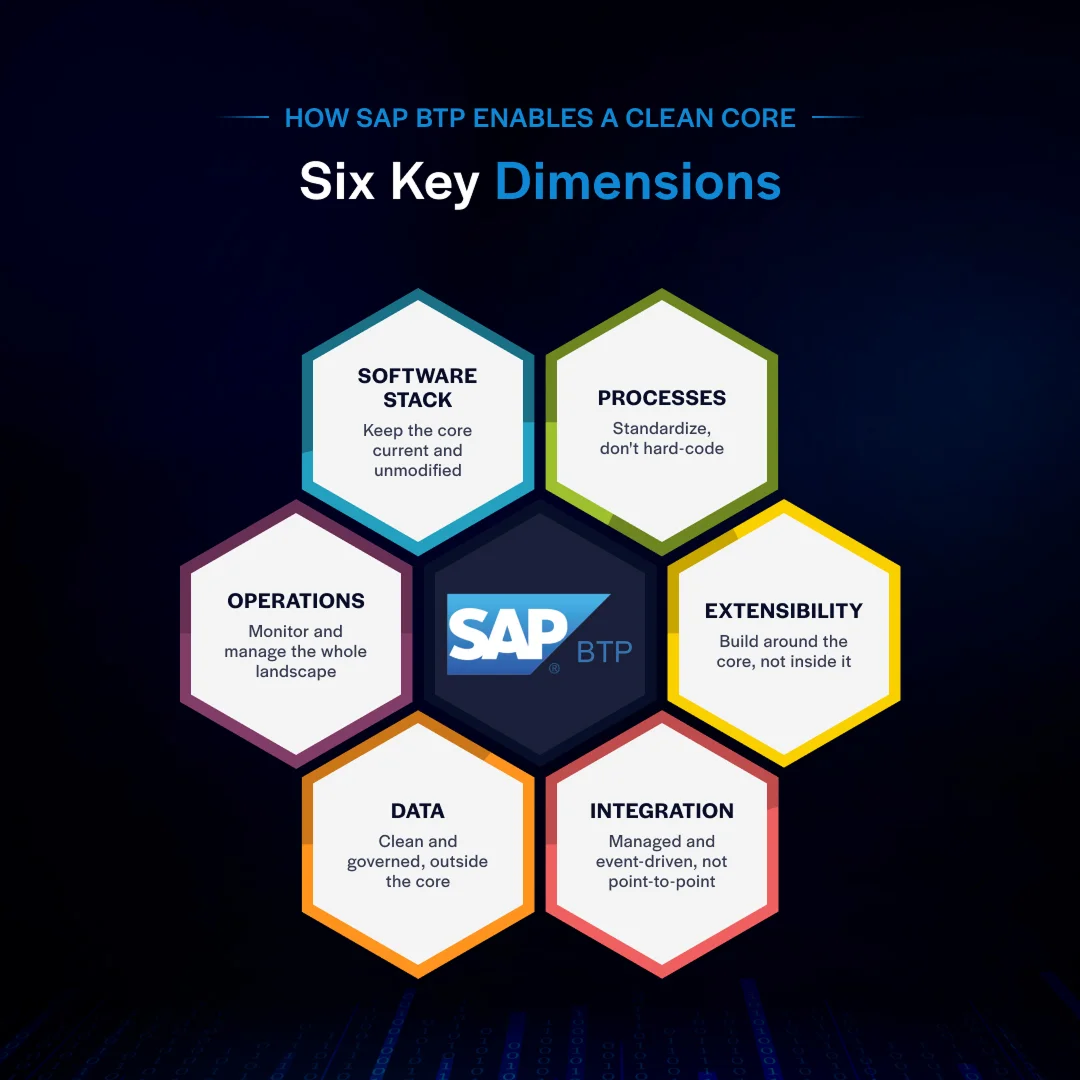
How SAP BTP Enables a Clean Core: Six Key Dimensions

Clean core isn’t only about custom code. SAP defines it across six dimensions — software stack, processes, extensibility, integration, data, and operations. A real clean core strategy keeps all six aligned to standard, and SAP BTP is what lets you do that without ever touching the S/4HANA core.

1. Software stack — keep the core current and unmodified

The cleanest core is one that stays on SAP’s standard and upgrades on SAP’s schedule. Where you do need custom ABAP, the ABAP environment on BTP gives developers a cloud-based ABAP runtime that lives outside S/4HANA. You still write ABAP — it just doesn’t sit in the core, so upgrades have nothing custom to break.

2. Processes — standardize, don’t hard-code

Custom workflows and approval chains used to live inside SAP, and every upgrade meant re-testing them. With SAP Build Process Automation on BTP, business users build and manage those flows using low-code tools — no ABAP, and nothing baked into the core. The process logic moves out; the core stays standard.

3. Extensibility — build around the core, not inside it

This is where most technical debt gets created. SAP gives you three tiers of extensibility: in-app (key-user, configuration-level changes), developer (on-stack ABAP Cloud, for logic that has to sit close to the data), and side-by-side (full custom apps on BTP using the Cloud Application Programming model or SAP Build Apps, connected through APIs). Side-by-side is the upgrade-safe home for anything that makes your business unique — the core never changes, so an upgrade has nothing to collide with.

4. Integration — managed and event-driven, not point-to-point

Most landscapes are held together by years of one-off, point-to-point connections that break the moment one system changes. SAP Integration Suite replaces that with pre-built connectors, governed integration flows, and a managed layer that survives upgrades. For real-time scenarios, advanced event mesh adds an event-driven, decoupled model: S/4HANA publishes business events — a sales order created, a goods receipt posted — and downstream systems consume them independently, on their own schedule. No direct dependency, no cascading failures.

5. Data — clean and governed, outside the core

A clean core needs clean data. SAP Datasphere and BTP’s data services let you build analytics, reporting, and data products on the platform instead of layering custom tables and extracts into S/4HANA. Your data stays governed and your core stays lean.

6. Operations — monitor and manage the whole landscape

Once your extensions live on BTP, you need a single view across all of it. SAP Cloud ALM gives you central monitoring and lifecycle management for the core and everything around it — so a clean core stays clean in production, not just on day one. 

Inline_SAP-BTP

Together, these six dimensions turn “keep the core clean” from a principle into an architecture — one where every upgrade is routine and every extension is built to last.   

What This Means for Your RISE with SAP Journey

If you’re exploring RISE with SAP, a clean core becomes the difference between a smooth migration and a painful, over-budget one.

RISE with SAP is SAP’s cloud transformation package. It bundles S/4HANA Cloud, infrastructure, and services into a single subscription. But to make the most of it, and to move to the cloud with confidence, your landscape needs to be clean.

Organizations with heavy customizations face the hardest migrations. Their code needs to be reviewed, rewritten, or removed before they can move. This adds months to the project and costs that weren’t in the original budget.

An SAP BTP clean core strategy changes this equation. By moving extensions to BTP before or during migration, you reduce the volume of custom code in the core. The migration becomes faster, cheaper, and lower risk.

The Business Case: What You Actually Gain

Here’s what a clean core strategy, powered by SAP BTP, delivers in practice:

Faster upgrades. With no custom code in the core, SAP updates are no longer a multi-month project. You can adopt new features as soon as SAP releases them.

Lower total cost of ownership. Maintaining custom ABAP code is expensive. Every developer hour spent on legacy modifications is an hour not spent on innovation. Moving extensions to BTP reduces that burden significantly, but first, you need to understand what custom code you’re actually carrying. MIRA, A5E’s AI-powered custom code migration tool, helps teams assess and remediate legacy ABAP code faster, so the path to a clean core is clearer from the start.

A smoother path to the cloud. Clean code migrates faster. Less custom logic in the core means fewer surprises during SAP S/4HANA migration — and less risk of going over budget.

Agility to innovate. With a stable, standard core, your team can adopt new SAP capabilities — including AI features embedded in S/4HANA — without worrying about compatibility. SAP S/4HANA transformation stops being a crisis and starts being a competitive advantage.

Read our case study on How an EMEA Retailer Cut Import Delays with S/4HANA

Is Your SAP Landscape Ready for This Shift?

Clean core is not a one-time project. It’s a long-term commitment to building on SAP the right way. And SAP BTP is what makes that commitment achievable.

If your team is still adding custom code to S/4HANA, every modification is debt you’ll pay back later — in upgrade costs, integration failures, and migration delays.

The shift starts with a simple decision: stop building inside the core, and start building on BTP.

Whether you’re preparing for a RISE with SAP move, mid-migration, or rethinking your existing S/4HANA landscape, the right architecture makes all the difference.

Ready to explore what a clean core strategy looks like for your organization?

Explore A5E’s SAP and Clean Core Solutions

Post a Comment

Fill the details to view the case study

    Please prove you are human by selecting the tree.

    Fill the details to view the case study

      Please prove you are human by selecting the tree.

      Fill the details to view the case study

        Please prove you are human by selecting the heart.

        Fill the details to view the case study

          Please prove you are human by selecting the heart.

          Fill the details to view the case study

            Please prove you are human by selecting the flag.